In Conclave, I used separate senior engineer, principal engineer and product manager reviewers to examine code and engineering proposals. Each reviewer had a different responsibility. The system also had to handle a less cooperative situation: a reviewer might be challenged on a correct answer, or asked to judge a design that lacked enough evidence for a confident verdict.
I wanted a way to tell whether different reviewer prompts changed the quality of the findings, including whether a reviewer could defend a finding when challenged.
What to measure in a persona review
Research has been mixed on persona prompting. A 2024 EMNLP study examined 162 personas over 2,410 factual questions and found no consistent overall accuracy gain from persona system prompts. A 2025 EMNLP study found that expert personas often had limited effect and that irrelevant persona details could degrade results.
These are studies of particular models and tasks, not a benchmark of Conclave or of software reviews generally. They are enough to reject a common assumption: a prompt saying "principal engineer" has not, by itself, demonstrated principal-engineer judgment.
I found it more useful to specify the review contract. A concurrency reviewer should identify shared state and describe an interleaving that violates an invariant. A product reviewer should tie a finding to an actual requirement. A reviewer who cannot support a finding should be able to return insufficient evidence rather than invent a reason to block the change.
To tell whether the contract helps, use the same challenge case and scoring criteria across three conditions: a general review prompt, an expert-role label, and a reviewer with explicit evidence requirements. Score whether the case was detected, whether the explanation names the relevant evidence and whether unsupported findings were introduced.
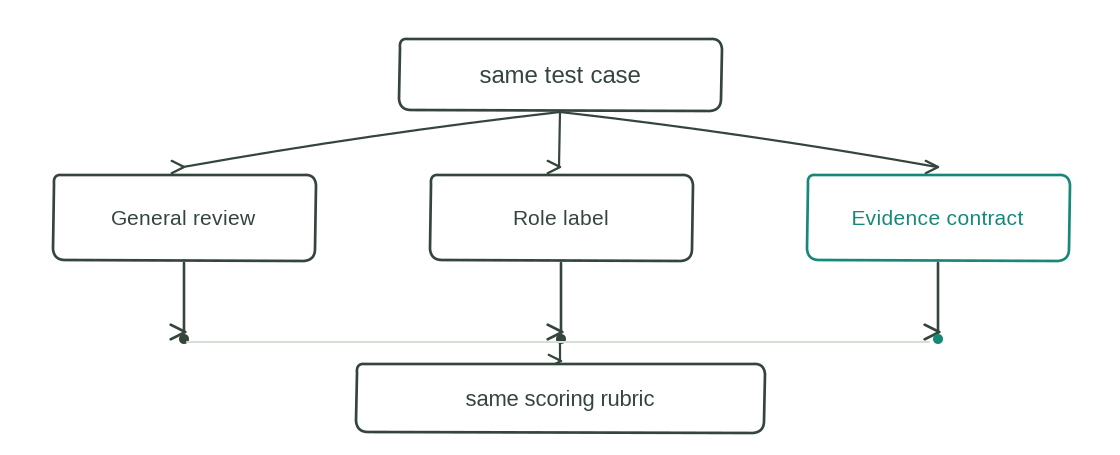
That experiment isolates the instruction change. It does not assume that agreement among several reviewers is proof. In Conclave's challenge exercises, I also tested how a reviewer responded when a correct answer was repeatedly disputed. A reversal without new evidence is a failure of the review process even when the final response sounds confident.
Multi-agent debate research gives another reason to measure the outcome. Debate improved performance on some evaluated tasks (Du et al., ICML 2024), while another comparison found that it did not consistently beat alternatives such as self-consistency or ensembling (Smit et al., ICML 2024). Google Research's agent-scaling study likewise reports that task structure matters: parallelizable work may benefit from additional agents, while sequential work can get worse.
For code review, independent checks of security, concurrency and requirements can be parallelized. The decision to merge is shared and needs one accountable outcome. Adding reviewers increases the number of opinions available; it also creates more disagreement and more opportunities for unsupported claims. The evaluation has to measure both.
The experiment I would ask a team to reproduce
Start with one engineering artifact containing a known concurrency defect. For example, a task reads a shared counter, awaits an external call and then writes back an incremented value. Two tasks can read the same starting value and lose one update. The expected finding is an interleaving, not a generic statement that "concurrency is risky."
Run the same artifact through three reviewer configurations with the same model, tools and input budget. The baseline asks for a general review. The second adds an expert title. The third assigns a specific responsibility and evidence requirements: identify the mutable state, name an unsafe schedule and explain which invariant breaks. The example is an evaluation design; it isn't a claimed numerical result from Conclave.
Now score more than whether a response sounds plausible. Did it identify the defect? Could another engineer reproduce its stated interleaving? Did it invent an unsupported fact? Did it refuse to issue a verdict when the artifact lacked required information? How long did the review take, and how many calls did it make?
These measurements separate several effects that are often collapsed into the word persona. A role label may alter style or what topics the model attends to. A review contract constrains the output and gives evaluators a way to decide whether a finding is supported. Multiple independent reviewers can supply more candidate findings, but they can also amplify a shared mistaken assumption. Agreement is not a ground truth label.
In my Conclave exercises, one challenge pattern involved pressing a reviewer to reverse a correct answer without introducing new evidence. That tests whether the review behaves like evidence assessment or like deference to the last confident speaker. A useful reviewer should be capable of updating when the evidence changes—and of holding its position when the evidence does not.
The research provides reasons to test rather than extrapolate. Zheng and colleagues' 2024 persona study measured factual-question accuracy, not code review or incident handling. The 2025 Principled Personas paper found limited or inconsistent expert-persona benefits and sensitivity to irrelevant details. The multi-agent debate papers also disagree about how robust the benefits are without tuning. A review architecture should therefore earn its complexity on the cases it actually handles. The paper results do not provide a measured uplift for this particular system.
From reviewer contracts to operational response
I've also used LangGraph to coordinate operational workflows involving validation, planning, approval, health checks, execution and monitoring. The same distinction between an opinion and a supported finding matters when a language model handles an incoming page.
Imagine an alert about elevated errors shortly after a deployment. An investigating agent can collect the alert window, relevant logs, recent changes and before/after service measurements. It can propose a cause and request a separate review of that hypothesis. A timestamp correlation alone doesn't establish that the deployment caused the errors.
For the operator, the handoff should carry the work already done: observed symptoms, a timeline, supporting and contradictory measurements, attempted checks, and the action that needs approval. A chat transcript is a poor substitute for that record. The operator needs to see what was established and which uncertainty remains.
An approval must be attached to a specific proposed effect. Approval to roll back one deployment cannot quietly authorize a different deployment, a wider resource scope or a modified command. That restriction belongs in the execution layer, independent of how persuasive the language model's explanation sounds.
A page is an investigation with an expiration date
The operational use case changes the meaning of a reviewer. A production page has a clock, potentially changing evidence, and an operator who may need to act before the investigation finishes. An agent that produces an excellent root-cause hypothesis twenty minutes after the incident was mitigated may not have helped.
Consider a generic service alert: error rate is elevated after a rollout. The investigation can gather deployment timestamps, compare request rates with the baseline, inspect upstream dependency health and summarize log samples. The system should retain the source and freshness of each observation. "Error rate is 8%" without a time window, service dimension or query reference is not useful evidence for an operator deciding whether to roll back.
There is an important counterexample. If the errors began before the deployment, a simple temporal narrative about the rollout is already suspect. A reviewer contract can require the agent to identify at least one observation that could falsify its leading hypothesis. The reviewer may conclude that evidence is insufficient. That is a better outcome than a polished diagnosis generated from a single coincident timestamp.
The case record also needs a handoff threshold. A human may be required because the action is high impact, because the model cannot resolve conflicting evidence, because a tool has failed, or because a time budget has expired. A stalled agent should not hold ownership of a page indefinitely while waiting for one more log query. The operator receives a bounded summary and links to the underlying observations, not just a long transcript of model messages.
I treat the action proposal separately from the diagnosis. It should name a specific target, parameters, expected effect, rollback or verification plan, approval scope and expiry. An operator can then approve that proposal. If the agent changes the resource or the command afterward, it needs a new decision. The executor verifies the binding; a language-model-generated explanation is not an access-control mechanism.
The difficult crash happens after the API call
LangGraph can persist graph state and pause for an operator with interrupts. Consider the point after the operator approves an action and before the workflow records its outcome.
The executor sends the request. The external service accepts it. The worker crashes before receiving or saving the response.
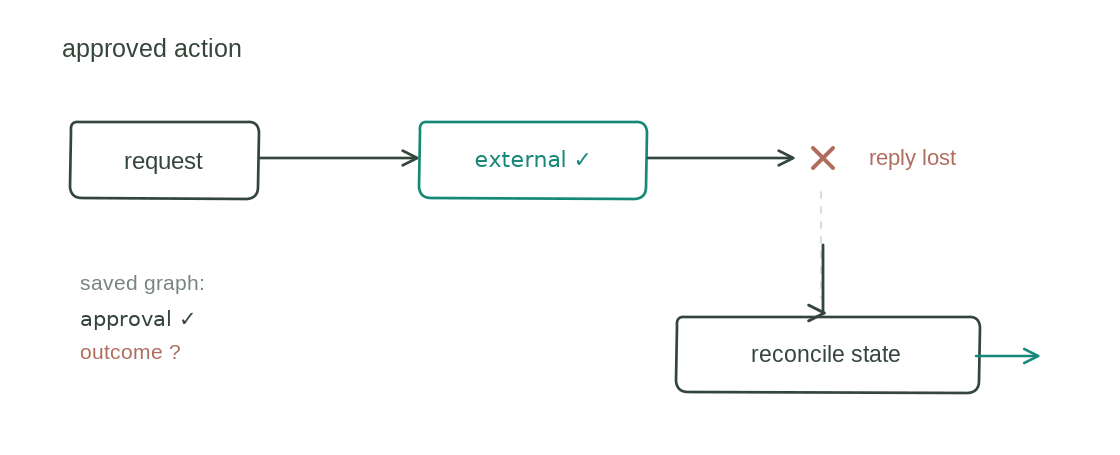
On recovery, the saved graph knows about the approval and attempted request. It cannot infer the external outcome from its own checkpoint. Sending the same request again may repeat a side effect that already occurred.
A stable operation identifier helps when the external API supports idempotency. Where the service exposes an authoritative status endpoint, the workflow can reconcile the operation before deciding to retry. If neither is available, the execution status remains unknown and the case needs human attention. An internal worker lease expiring does not cancel an external request already in flight, either.
The execution record therefore needs the action identity, its approval scope and the outcome of reconciliation alongside the investigation. The coordinator, reviewer and executor have different authorities, even when they use the same underlying model.
Persistence changes how a LangGraph node should be written
LangGraph provides checkpointed state and human-interrupt primitives, but a checkpoint doesn't snapshot an arbitrary Python or JavaScript process at an instruction pointer. The current interrupt documentation explains that a resumed interrupted node runs from its beginning. Work performed before the interruption can therefore execute again.
This matters even before discussing an external failure. If a node generates a fresh operation ID, calls an API and then invokes an interrupt for approval, resuming that node can repeat the preparation and possibly the effect. The safer shape separates evidence collection, approval and effect execution into explicit boundaries. The proposal should have a stable identity before it is shown to an operator, and effect-producing tasks should be replay-safe.
A possible record for an operational action has fields such as case_id, proposal_id, target, parameters_hash, approved_by, approval_expires_at, attempt_id, external_operation_id and result_status. These field names are generalized examples, not an exported private schema. Their purpose is to tie the human decision to the exact effect and to distinguish approved, attempted, confirmed and unknown outcomes.
There are at least three useful recovery cases to test. If execution fails before sending the request, it can often retry safely. If the external API confirms an idempotent operation, it can reconcile using the stable key. If the request may have succeeded but has no idempotency or status query, it must not invent a success result or blindly repeat a potentially destructive action. That last case belongs with the operator.
Durability also brings mundane lifecycle problems: duplicate alerts, stale evidence, a case assigned to a worker that no longer exists, and approvals that expire while the graph is paused. An always-on assistant needs to distinguish a new observation from a new case and a worker's lease from authority to act. An expired lease permits reassignment; it does not revoke an external operation already accepted by a remote service. These distinctions are as relevant to recurring financial checks and scheduled maintenance as they are to incident management.
What changes when an agent stays around
An always-on workflow can receive work from a scheduled check, a direct request or an alert. Those triggers need durable case identities so the system can pause, wake up again and hand work between operators without losing the evidence or replaying an uncertain external action.
The practical structure that emerged from the Conclave and LangGraph work is a main coordinator with specialized reviews, an explicit executor and a handoff path. The review contracts help the system inspect its own proposals; the persistence and execution rules let it survive interruptions. Neither mechanism supplies authority to take an action. That authority still has to be granted and checked per operation.
What I would report from an evaluation
One success number would hide too much. For the reviewer, I want defect recall, unsupported-finding rate and whether a reviewer changed its conclusion without new evidence. For an operational investigation, I want the fraction of cases with traceable evidence, time to a useful handoff, unnecessary escalation rate and whether a proposed action matched the authority granted. For execution, I want replay and recovery tests that simulate a crash at each external-action boundary.
These are evaluation criteria, not results I am claiming to have achieved. The frameworks and challenge cases informed the design; the cited research supplies independent findings about persona prompts and multi-agent coordination. A private implementation and an external study are two different kinds of evidence, and neither should be substituted for the other.
A reader can apply the approach without adopting Conclave or LangGraph: specify a role's evidence contract, hold the test input fixed, track unsupported claims, preserve case state, and design a way to reconcile every external action before retrying it.
A regression suite for this workflow should include unsupported root-cause claims, unnecessary escalations and cases where an action succeeds but its reply is lost. Each case should end with a verified state or an explicit operator handoff. A completed graph run does not pass if it repeated an uncertain action or left the operator without the evidence needed to decide what to do next.